Kyrgyzstan Medical University Accreditation 2026: 13 Institutions Denied, 4 Get 6-Year Approval
Introduction to Kyrgyzstan Medical University Accreditation 2026
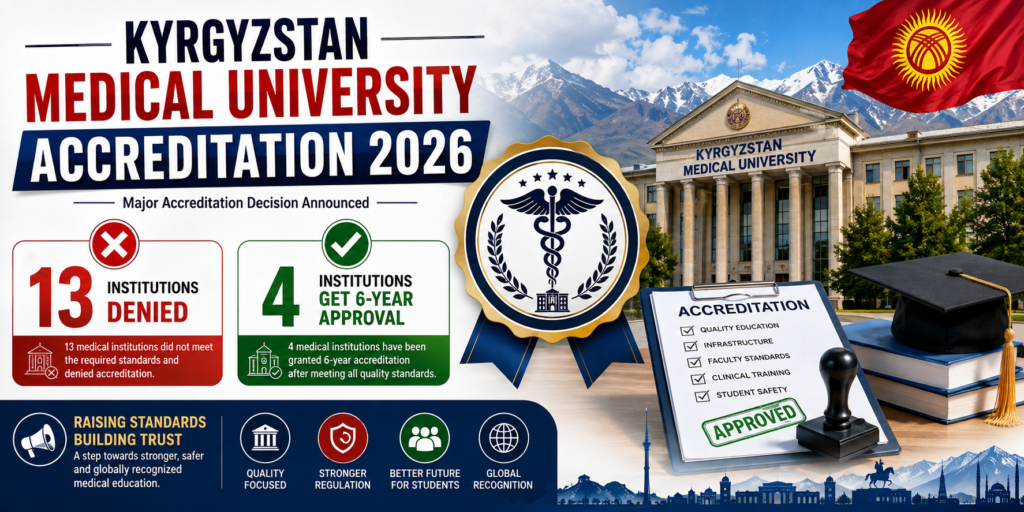
If you’re an aspiring MBBS student eyeing Kyrgyzstan for your medical education, there’s an important update you can’t afford to miss. The Ministry of Health of Kyrgyzstan has wrapped up its 2026 state accreditation review of the country’s medical universities — and the results carry real consequences for anyone planning to apply this admission cycle.
Out of the medical institutions that underwent evaluation, 13 failed to secure accreditation altogether, while only a handful of universities walked away with the maximum six-year approval. For Indian and other international students weighing where to pursue MBBS abroad, this accreditation status is not just a formality — it directly affects the validity and recognition of the degree you’ll eventually earn.
Here’s a complete breakdown of what happened, why it matters, and what you should check before submitting any application.
Why Kyrgyzstan Medical University Accreditation Matters
Kyrgyzstan has built a strong reputation as an affordable, accessible destination for MBBS aspirants, drawing thousands of international students every year. But not every university operating in the country meets the standards required to deliver quality medical training — which is exactly why this periodic accreditation review exists.
The Ministry’s evaluation in May 2026 assessed institutions across several critical parameters:
- Faculty strength and staffing quality
- Availability and adequacy of clinical training facilities
- Material and technical infrastructure
- Structure and content of educational programs
- Organization of the overall teaching process
- Overall standard of specialist training delivered
A university that fails to clear these benchmarks risks losing its authorization to award recognized medical qualifications — a red flag no student should ignore.
Accreditation Results at a Glance
Kyrgyzstan currently has 34 medical universities in operation (12 public and 22 private), but only 24 institutions took part in this year’s accreditation cycle. Here’s how the results broke down:
- 4 universities earned the full 6-year accreditation — the strongest possible endorsement.
- 7 universities were granted a conditional 1-year accreditation, meaning they’ll need to be reassessed soon.
- 13 institutions failed the review entirely and did not receive accreditation.
Universities That Received 6-Year Accreditation
These institutions demonstrated the strongest compliance with the Ministry’s standards and secured the longest accreditation period available:
- International Higher School of Medicine (IHSM)
- Osh State University
- Educational, Scientific and Production Complex – International University of Kyrgyzstan
- Asian International University named after S. Tentishev
If you’re prioritizing long-term stability and recognition, these four should be at the top of your shortlist.
Universities Granted 1-Year (Conditional) Accreditation
The following seven universities passed the review but only received a one-year window, which typically signals areas the institution still needs to improve before its next evaluation:
- Jusup Balasagyn Kyrgyz National University
- Jalal-Abad State University
- Kyrgyz-Uzbek International University
- Issyk-Kul State University
- Jalal-Abad International University
- University of South Asia
- International European University
Students considering these options should keep a close eye on future accreditation updates, since a short-term status can change again at the next review cycle.
The 13 Universities That Failed Accreditation in 2026
This is the section every MBBS aspirant should read carefully. The following institutions did not meet the Ministry of Health’s required standards and failed to receive accreditation this cycle:
- Avicenna International Medical University
- ADAM University
- Royal Metropolitan University
- Altamimi International University
- Ala-Too International University
- International Medical University
- Kyrgyz Medical and Dental Institute
- Salymbekov University
- Eurasian International University
- Bishkek International Medical Institute
- International University of Medicine and Science
- Central Asian International Medical University
- Osh International Medical University
Applying to, or continuing studies at, an unaccredited institution can create serious complications later — from degree recognition issues to eligibility hurdles for licensing exams back home.
What This Means for MBBS Aspirants
For students — particularly from India — planning to study MBBS in Kyrgyzstan, this accreditation update is a timely reminder to do your homework before committing to any university. A low tuition fee or an attractive campus brochure means little if the institution can’t guarantee a recognized, quality medical education.
Before applying, make sure to:
- Verify the university’s current accreditation status directly with the Ministry of Health of Kyrgyzstan
- Cross-check recognition with relevant regulatory bodies in your home country
- Avoid relying solely on agent or consultancy claims — confirm details independently
- Track accreditation renewals if you’re considering a 1-year-accredited institution
Frequently Asked Questions
Q1. How many medical institutions failed state accreditation in Kyrgyzstan in 2026?
A total of 13 medical universities failed to pass the Kyrgyz Ministry of Health’s 2026 state accreditation review.
Q2. Which authority conducted the accreditation review?
The review was carried out by the Ministry of Health of Kyrgyzstan.
Q3. Why is this accreditation review conducted?
It’s conducted to evaluate the quality of medical education, faculty, clinical infrastructure, academic programs, and overall training standards across the country’s medical universities.
Q4. Which Kyrgyzstan medical universities received the longest accreditation period?
Four universities — International Higher School of Medicine, Osh State University, the International University of Kyrgyzstan’s Educational-Scientific-Production Complex, and Asian International University named after S. Tentishev — received 6-year accreditation.
Q5. Should I avoid universities with only 1-year accreditation?
Not necessarily, but you should monitor their status closely, since a 1-year accreditation indicates the institution needs further review before a longer-term approval is granted.